Contar elementos en el modelo
Objetivo del script
Si quieres obtener una visión general de lo que hay en un modelo y cuántos objetos contiene:
- Cuántas medidas hay en un modelo.
- Cuántas columnas y columnas calculadas hay en un modelo.
- Cuántas tablas y tablas calculadas hay en un modelo.
- Cuántas relaciones, relaciones inactivas, etc., hay.
Script
Contar el número de objetos del modelo por tipo
// This script counts objects in your model and displays them in a pop-up info box.
// It does not write any changes to this model.
//
// Use this script when you open a new model and need a 'helicopter view' on the contents.
//
// Count calculation groups & calculation items
int _calcgroups = 0;
int _calcitems = 0;
foreach (  var _calcgroup  in Model.CalculationGroups )
{
    _calcgroups = _calcgroups + 1;
    foreach (  var _item  in _calcgroup.CalculationItems )
    {
        _calcitems = _calcitems + 1;
    }
}

// Count partitions and DAX parameters
int _partitions = 0;
int _whatifparameters = 0;
int _fieldparameters = 0;
foreach (  var _table  in Model.Tables )
{
    foreach (  var _partition  in _table.Partitions )
    {
        string _type = Convert.ToString(_partition.SourceType);
        string _exp = Convert.ToString(_partition.Expression);
        if ( _type == "M" )
        {
            _partitions = _partitions + 1;
        }
        else if ( _type == "Calculated" && _exp.Contains("NAMEOF") )
        {
            _fieldparameters = _fieldparameters + 1;
        }
        else if ( _type == "Calculated" && _exp.Contains("GENERATESERIES") )
        {
            _whatifparameters = _whatifparameters + 1;
        }

    }
}

// Average measure length
decimal _numLines = 0;
decimal _numChars = 0;
int _measures = Model.AllMeasures.Count();
foreach ( var _measure in Model.AllMeasures )
{
    _numLines = _numLines + _measure.Expression.Split("\n").Length;
    _numChars = _numChars + _measure.Expression.Length;
}
_numLines = Math.Round(_numLines / _measures, 1);
_numChars = Math.Round(_numChars / _measures, 1);


// Return the pop-up
Info ( "In the model, we see the below objects:\n\n"

        + "-----------------------------------------\n"
        + "Data Objects\n"
        + "-----------------------------------------\n"
        + " ├─ PQ Expressions: " + Convert.ToString(Model.Expressions.Count()) + "\n"
        + " │\n"
        + " └─ Tables: " + Convert.ToString(Model.Tables.Count()) + "\n"
        + "       ├─ Incremental Refresh Tables: " +
            Convert.ToString(Model.Tables.Where(
                _ir =>
                Convert.ToString(_ir.EnableRefreshPolicy)
                ==
                "True").Count()) + "\n"

        + "       │\n"
        + "       ├─ Calculated Tables: " +
            Convert.ToString(
                Model.Tables.Where(
                    _tables =>
                    Convert.ToString(_tables.Columns[0].Type)
                    ==
                    "CalculatedTableColumn").Count()) + "\n"

        + "       │   ├─ What if parameters: " +
            Convert.ToString(_whatifparameters) + "\n"
        + "       │   └─ Field parameters: " +
            Convert.ToString(_fieldparameters) + "\n"
        + "       │\n"
        + "       ├─ M Partitions: " +
            Convert.ToString(_partitions) + "\n"
        + "       │\n"
        + "       └─ Total Table Columns: " +
            Convert.ToString(Model.AllColumns.Count()) + "\n\n"

        + "-----------------------------------------\n"
        + "DAX Objects\n"
        + "-----------------------------------------\n"
        + " ├─ Relationships: " +
            Convert.ToString(Model.Relationships.Count()) + "\n"
        + " │   ├─ Bi-directional: " +
            Convert.ToString(Model.Relationships.Where(
                _relationships =>
                Convert.ToString(_relationships.CrossFilteringBehavior)
                ==
                "BothDirections").Count()) + "\n"

        + " │   ├─ Many-to-Many: " +
            Convert.ToString(Model.Relationships.Where(
                _relationships =>
                Convert.ToString(_relationships.FromCardinality)
                ==
                "Many"
                &&
                Convert.ToString(_relationships.ToCardinality)
                ==
                "Many").Count()) + "\n"

        + " │   ├─ One-to-One: " +
            Convert.ToString(Model.Relationships.Where(
                _relationships =>
                Convert.ToString(_relationships.FromCardinality)
                ==
                "One"
                &&
                Convert.ToString(_relationships.ToCardinality)
                ==
                "One").Count()) + "\n"

        + " │   └─ Inactive: " +
            Convert.ToString(Model.Relationships.Where(
                _relationships =>
                Convert.ToString(_relationships.IsActive)
                ==
                "False").Count()) + "\n"

        + " │\n"
        + " ├─ Calculation Groups: " +
            Convert.ToString(_calcgroups) + "\n"
        + " │   └─ Calculation Items: " +
            Convert.ToString(_calcitems) + "\n"
        + " │\n"
        + " ├─ Calculated Columns: " +
            Convert.ToString(Model.AllColumns.Where(
                _columns =>
                Convert.ToString(_columns.Type)
                ==
                "Calculated").Count()) + "\n"

        + " │\n"
        + " └─ Measures: " +
            Convert.ToString(_measures) + "\n"
        + "     └─ Avg. Lines of DAX: " +
            Convert.ToString(_numLines) + " Lines \n"
        + "     └─ Avg. Chars of DAX: " +
            Convert.ToString(_numChars) + " Characters \n\n"

        + "-----------------------------------------\n"
        + "Other Objects\n"
        + "-----------------------------------------\n"
        + " ├─ Data Security Roles: " +
            Convert.ToString(Model.Roles.Count()) + "\n"
        + " ├─ Explicit Data Sources: " +
            Convert.ToString(Model.DataSources.Count()) + "\n"
        + " ├─ Perspectives: " +
            Convert.ToString(Model.Perspectives.Count()) + "\n"
        + " └─ Translations: " +
            Convert.ToString(Model.Cultures.Count()));
Explicación
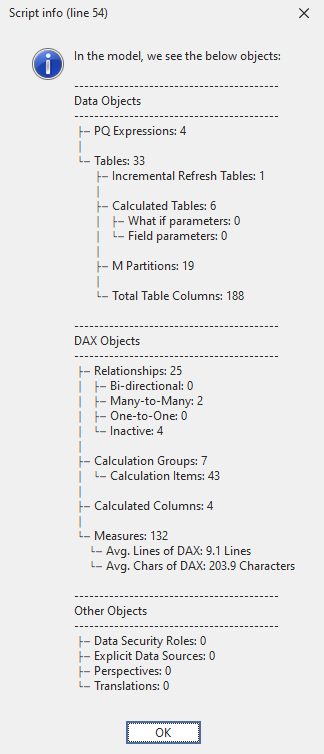
Este fragmento recorre el modelo y cuenta los distintos tipos de objeto, mostrándolos en un formato jerárquico de tipo «árbol de nodos», construido manualmente. Puedes comentar las partes que no necesites para tus propósitos.
Salida de ejemplo